
Global AI newsletter
AI on the Farm Needs More Than a Dashboard
A new federal investment and Canadian agriculture research put the focus on a practical question for Saskatchewan: how do AI tools earn trust in the field?
What changed
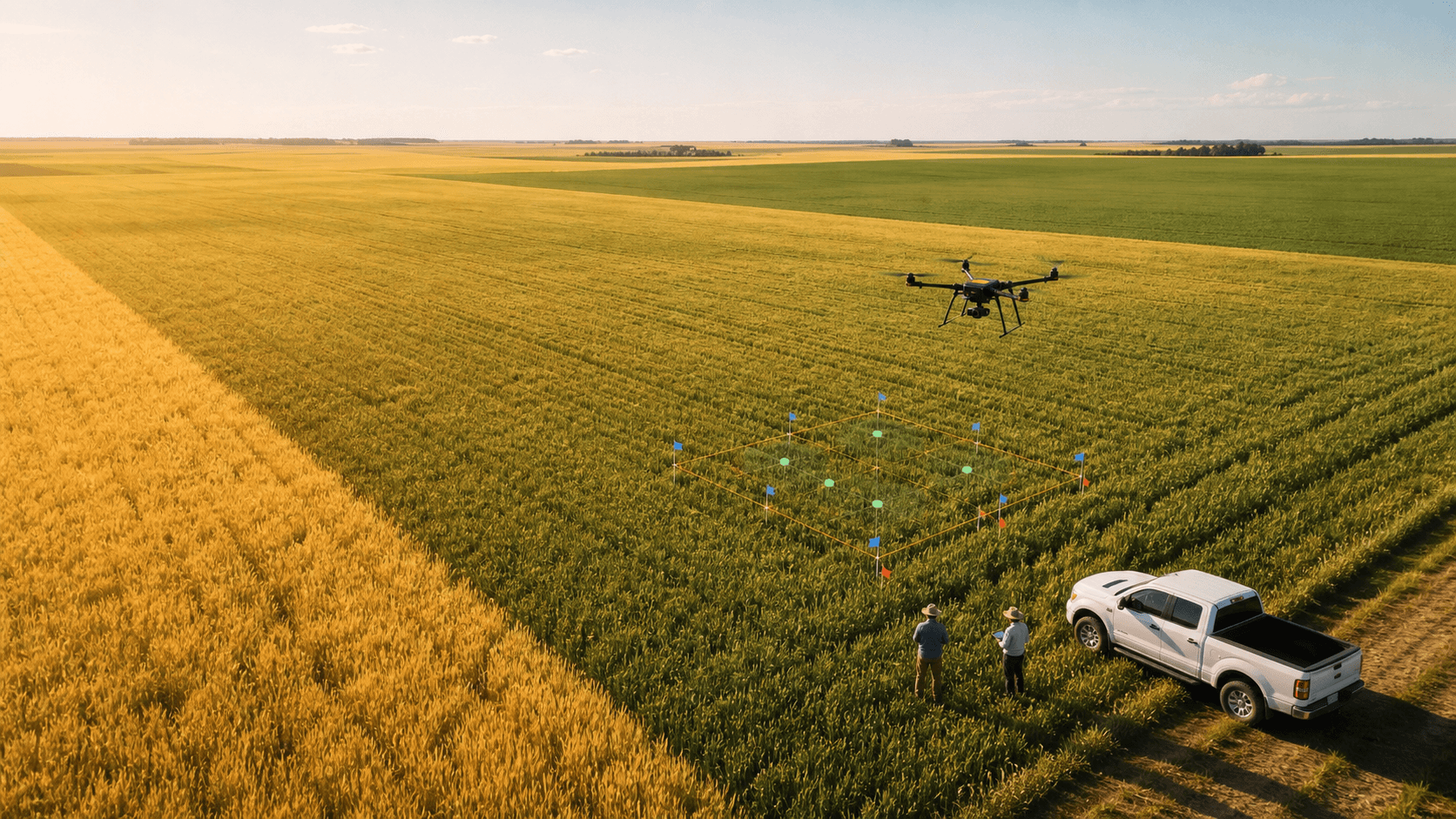
On July 9, 2026, Agriculture and Agri-Food Canada announced up to $1.65 million for A.U.G. Signals Ltd. to lead a three-year project on AI-driven crop-health monitoring and yield forecasting. The proposed tools will combine satellite, drone, and field data to assess crop emergence, above-ground biomass, drought conditions, and yield predictions in real time.
The announcement is especially relevant because it describes field-data collection and AI-model validation as part of the work with federal scientists. That is a stronger signal than simply saying a model can analyse images. It recognizes that an output has to be compared with conditions on the ground before it can reliably support a decision.
The same week, the federal government launched the fifth phase of CanCode, a $30 million program intended to expand digital and AI learning opportunities for students and teachers. Together, these updates point to two pieces of practical AI readiness: tools that can be tested in real settings, and people who can understand enough to question and use them well.
Why field validation matters
Remote sensing is the use of data gathered away from the object being measured, such as satellite or drone imagery. It can help reveal patterns across a large area. But a promising pattern is not automatically a recommendation. A yellow patch in an image might relate to moisture, crop stage, a sensor issue, or something else that needs a closer look.
Ground truth is the plain-language check: compare a prediction with what is actually happening in the field. For an agricultural AI tool, that can mean checking samples, weather records, equipment data, agronomic observations, and outcomes from previous seasons. The more a recommendation affects inputs, timing, money, or risk, the more important that check becomes.
This is not an argument against using AI. It is a way to use it responsibly. A tool can help narrow the area that needs attention, organize information, or surface a useful question for an agronomist or producer. It should not make local expertise, inspection, or accountability disappear behind a confident-looking score.
The Saskatchewan opportunity is an ecosystem question
Farm Credit Canada’s research on AI in Canadian agriculture and food argues that adoption is uneven and tied to more than software access. It points to high-quality data, reliable connectivity, skilled labour, investment, governance, and accountability as connected conditions for useful adoption. That framing fits Saskatchewan, where farm operations, rural connectivity, research institutions, agri-food businesses, students, and public partners all shape whether a promising pilot becomes everyday value.
For a producer or agri-food business, the first useful question is often small: what decision would this tool improve, and how will we know? A clear answer might be earlier scouting, a more consistent record, a better estimate to discuss with an adviser, or a way to compare conditions across fields. If the answer is only that the dashboard looks sophisticated, the case for adoption is incomplete.
For students and educators, this is a reminder that AI literacy includes knowing what a model sees, what it cannot see, and how its results are checked. The best pathway is not just learning to operate a new tool. It is learning to ask sensible questions about data, uncertainty, local context, privacy, and the people responsible for the final decision.
What AiSK members should watch
Watch for agricultural AI projects that explain their validation plan. Useful signals include the local conditions being tested, the data used for comparison, who reviews unexpected results, and how producers can question or correct an output.
Watch for practical data conversations. As more farm data moves among equipment, platforms, advisers, researchers, and service providers, people should be clear about what is collected, who can use it, how long it is kept, and what value comes back to the operation sharing it.
Watch for learning and convening opportunities that bring producers, agronomists, researchers, students, Indigenous communities, agri-food businesses, and public institutions into the same conversation. AiSK can help translate the technology, connect people who need to compare notes, and keep responsible adoption grounded in Saskatchewan realities.
Sources
- Government of Canada invests in artificial intelligence and remote sensing for climate-smart agricultureAgriculture and Agri-Food Canada, July 9, 2026
- FCC Thought Leadership exploring AI opportunities for Canadian agriculture and foodFarm Credit Canada, May 27, 2026
- Government of Canada invests $30 million to launch fifth phase of CanCode program to offer new training opportunities for youth and teachersInnovation, Science and Economic Development Canada, July 8, 2026
- Workplace artificial intelligence use: A profile of sociodemographic and job characteristicsStatistics Canada, June 17, 2026
AiSK helps Saskatchewan learn, convene, and ask better questions about responsible AI adoption.
Explore AiSK membership