
Global AI newsletter
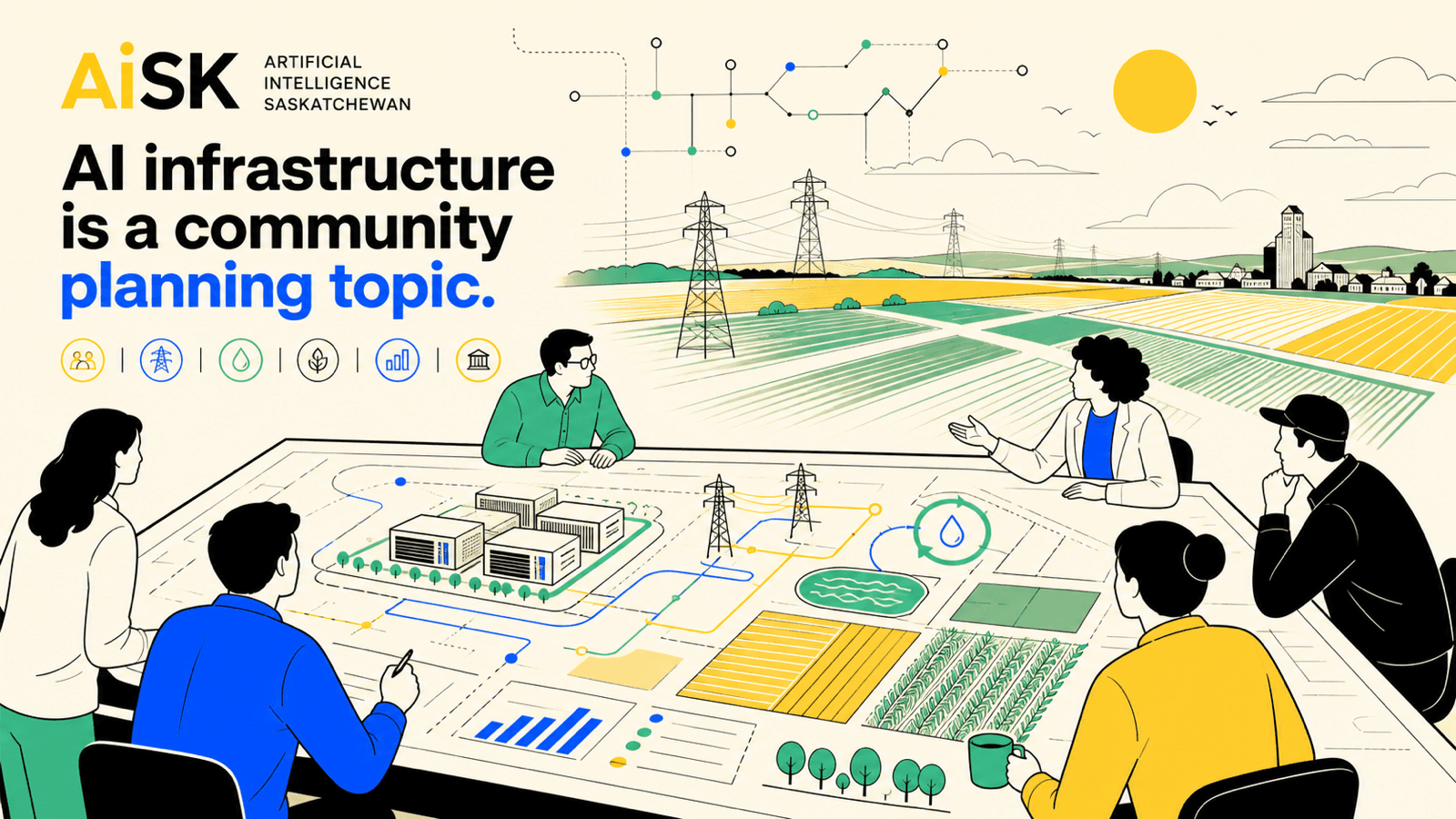
AI Infrastructure Is a Community Planning Topic
Recent AI data-centre, chip, power, and water stories show why Saskatchewan communities should treat AI infrastructure as a public planning and literacy issue, not only a technology trend.
What changed
On June 24, 2026, Axios reported that OpenAI is testing its first in-house AI chip, developed with Broadcom and aimed first at inference, the work of running models for users rather than training them from scratch. The detail matters because it shows major AI labs trying to control more of the compute stack behind everyday tools.
The same day, Axios reported Microsoft is emphasizing data-centre designs that avoid water-consuming cooling towers during normal operations by recirculating coolant directly to chips and using air-cooled chillers. On June 23, The Verge reported Nvidia's Rubin-generation reference design also leans on liquid cooling and higher operating temperatures to reduce water use.
Power is moving into the story too. People reported on June 23 that Chevron and Microsoft have a 20-year agreement tied to a large AI data-centre power project in West Texas. The project is not in Saskatchewan, but the pattern is relevant anywhere AI demand begins to meet power planning, permitting, water questions, and community consent.
Why this matters for Saskatchewan
Saskatchewan does not need to host a hyperscale AI campus tomorrow for this to matter. The infrastructure choices now being made by global companies influence cloud prices, tool access, reliability, energy demand, and the public expectations that will follow AI into schools, farms, public services, startups, health systems, research labs, and small businesses.
For communities, the useful question is not simply whether AI is good or bad. It is what physical requirements sit behind a proposed AI service or facility: how much power it needs, how it is cooled, where the water comes from, who pays for grid upgrades, what local benefits are promised, and how claims will be verified over time.
This is also a Canadian competitiveness issue. If compute becomes a bottleneck, then access to efficient infrastructure, transparent rules, and trained people will shape who can build, test, and adopt AI. Saskatchewan's AI conversation should include technical builders, utilities, municipalities, Indigenous communities, agriculture, universities, polytechnics, public institutions, entrepreneurs, and residents who want plain-language answers.
The literacy lens
The June 19 arXiv overview on AI data centres and power-system sustainability describes a tension Saskatchewan readers will recognize: concentrated electricity demand can challenge grids, but the sector may also create opportunities for cleaner energy integration, flexibility, and better planning. In plain language, AI infrastructure can be a strain or a catalyst depending on how it is governed.
Cooling claims need the same careful reading. A data centre may reduce direct water use for cooling and still have indirect water impacts through electricity generation, chip manufacturing, or local construction. That does not make the engineering progress meaningless. It means communities need the vocabulary to compare direct water use, indirect water use, power source, reliability, emissions, noise, land use, and economic benefit.
The Associated Press coverage on June 24 is a reminder that ordinary AI use has resource costs too. For most readers, the point is not to feel guilty about every useful query. It is to understand that AI adoption at scale has a footprint, and that responsible use includes asking whether a tool is genuinely helping with the task at hand.
What AiSK members should watch
Watch for AI infrastructure proposals being framed only as jobs, investment, or innovation. Those benefits may be real, but good public discussion should also include power demand, water use, local tax arrangements, environmental review, procurement terms, and who gets durable access to the resulting capability.
Watch for efficiency claims that sound absolute. Better chips, liquid cooling, and closed-loop systems can reduce specific impacts, but they do not automatically answer questions about total demand, rebound effects, energy source, or community trade-offs.
Watch for local learning opportunities. AiSK can help Saskatchewan keep this discussion practical by convening people across sectors, translating technical claims into plain language, and helping members ask informed questions before AI infrastructure decisions become locked in.
Sources
- OpenAI fires up "Jalapeño," its first homegrown AI chipAxios, June 24, 2026
- Microsoft points to lower water use in AI eraAxios, June 24, 2026
- Nvidia says its AI data center design runs hotter to use a lot less waterThe Verge, June 23, 2026
- Chevron Signs Deal with Microsoft to Power AI Data Center That Could Become One of the Country's LargestPeople, June 23, 2026
- AI Data Centers and Power System Sustainability: Understanding the Sustainability Implications of AI-Driven Data Centers on Power SystemsarXiv, June 19, 2026
- AI is an energy and water hog, here's what you can do to counter thatAssociated Press, June 24, 2026
AiSK helps Saskatchewan learn, convene, and ask better questions about responsible AI adoption.
View AiSK events